
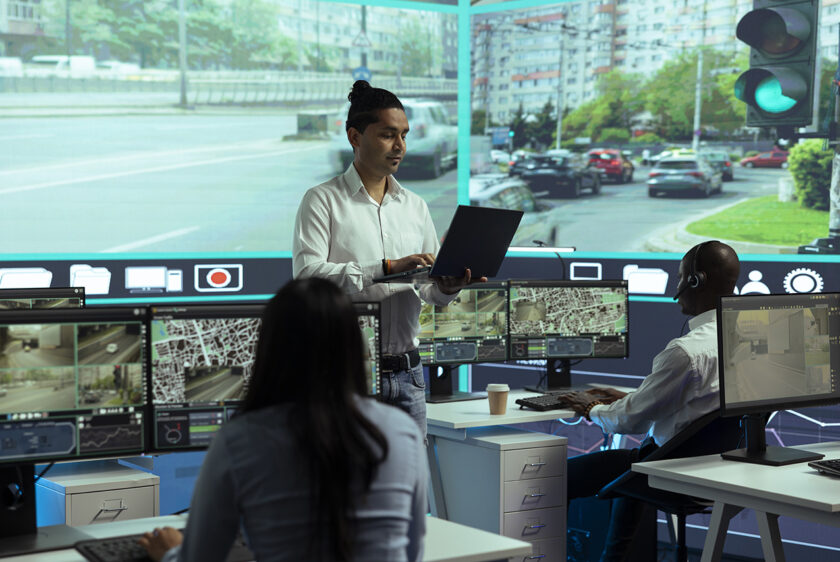
For most of the past 30 years, CCTV meant cameras, recorders, and a monitor in a back office that nobody watched unless something went wrong. The footage was there if you needed it for an investigation. The system was not doing much in real time.
A significant number of UAE organisations are now replacing that model with AI-driven security solutions that actively monitor, detect, and alert rather than passively record. The shift is practical, not just technological. The organisations driving it are responding to real operational problems: too many cameras for human monitoring teams to watch effectively, too many false alarms from legacy motion detection, and the growing expectation that security infrastructure should do more than provide post-incident evidence.
This article explains why UAE organisations are making this move, what it involves in practice, and what end users should understand before committing to an upgrade.
The Problem With Reactive CCTV
Reactive CCTV works on a simple model. Something happens. Someone reviews the footage. Action is taken. The camera’s job is to record what happened, not to do anything about it.
In a small, well-monitored environment, this model is adequate. In most real-world UAE deployments, it is not. The scale of modern commercial, hospitality, and public sector facilities means that effective monitoring of a conventional camera network requires more human attention than most organisations can provide consistently.
Research in the security industry consistently shows that human operators watching live CCTV feeds lose concentration significantly after 20 minutes. After an hour, the quality of monitoring degrades to a point where many events are missed entirely. This is not a criticism of the people doing the job. It is a fundamental limitation of asking humans to perform continuous, low-stimulus monitoring at scale.
The result is that many conventional CCTV systems are performing primarily as evidence-collection infrastructure rather than active security systems. Valuable after the fact. Less valuable in real time.
What AI-Driven Security Solutions Do Differently
AI-driven security solutions address the human attention problem directly. The system watches all feeds simultaneously, continuously, without the attention degradation that affects human monitors. When something meets a defined detection criterion, it generates an alert and directs human attention to that specific event.
This changes the role of the security operator from passive watcher to active responder. Instead of scanning a grid of 50 camera feeds and hoping to catch something, the operator is responding to specific, prioritised alerts generated by a system that has already filtered out the background noise.
The practical capabilities that AI-driven security solutions add over conventional CCTV:
- Real-time crowd density monitoring with threshold alerting, before conditions become dangerous rather than after
- Behaviour detection including loitering, perimeter crossing, object abandonment, and unusual movement patterns
- Automated event categorisation that separates genuine security alerts from environmental triggers such as lighting changes or weather conditions
- Integration of video analytics with access control data, so an alert includes the contextual information needed to respond appropriately
- Historical analytics that identify patterns over time, not just individual incidents
For a detailed look at the technology behind AI surveillance, see our article on the rise of AI in video surveillance.
What the Upgrade Process Looks Like
Moving from reactive CCTV to AI-driven security solutions does not always require replacing every camera on site. In many cases, a phased approach is more practical and more cost-effective.
Phase 1: Assessment
A site survey identifies which existing cameras can be retained, which zones need upgraded hardware to support AI analytics, and what the network infrastructure can handle. This phase also defines the detection requirements for each area at what sensitivity levels.
Phase 2: Core Infrastructure
The VMS is typically upgraded first. A modern VMS that supports AI analytics integration is the platform everything else connects to. In many sites, this upgrade alone improves the operational experience significantly, even before new cameras are added.
Phase 3: Camera Upgrade
AI analytics cameras are deployed in priority zones first. High-traffic entry points, perimeter boundaries, and areas with a history of incidents are the typical starting points. The rollout expands from there based on operational priority.
Phase 4: Training and Configuration Refinement
Detection zones need to be configured for each camera based on the specific environment. Alert thresholds need to be calibrated to reduce false positives without missing genuine events. Operators need to understand how to interpret and respond to AI-generated alerts.
The configuration refinement phase typically runs for four to six weeks after go-live. AI analytics systems improve with tuning, and tuning requires real-world operational data. This is normal and expected.
What UAE Organisations Discover After Making the Switch
Samcom has supported organisations across the UAE through this transition, across sectors including entertainment, retail, hospitality, and critical infrastructure. A few consistent findings emerge from post-implementation reviews.
The reduction in false alarms is the most immediately noticed improvement. Organisations that were dealing with dozens of motion-triggered alerts per shift from conventional systems report a significant reduction after switching to AI-driven detection. This alone changes the relationship between the operations team and the security system.
The second finding is that the AI system surfaces patterns that were not visible before. Not just individual incidents, but recurring events in specific zones at specific times. This data drives operational improvements that go beyond security, including venue flow adjustments and staffing deployment changes.
The third is that the integration between surveillance and access control creates an operational efficiency that organisations did not fully anticipate before implementation. When an access alert and the relevant camera feed arrive together, response time is significantly reduced compared to a system where those two data sources need to be manually correlated.
Samcom’s project work across UAE venues and facilities is documented on the projects page.
Factors to Consider Before Making the Move
The case for AI-driven security solutions is strong, but the decision needs to be made with a clear understanding of what is involved.
- Network infrastructure. AI-capable cameras generate more data than conventional cameras. The existing network needs to be assessed for capacity before deployment. Under-specified network infrastructure is a common cause of performance problems in the first year after an upgrade
- Storage requirements. AI analytics generate metadata in addition to video footage. Storage requirements increase with AI deployment. Cloud storage options can address this, but they need to be factored into the budget
- Change management. The shift from passive CCTV monitoring to active AI alert response is a significant operational change for security teams. Training and process redesign are as important as the technology itself
- Staged rollout vs full replacement. In most cases, a staged rollout starting with priority zones and expanding from there is more manageable than a full-site replacement
Frequently Asked Questions
Do I need to replace all my existing cameras to move to AI-driven security?
Not necessarily. Some existing cameras can be retained and supplemented with AI-capable cameras in priority zones. A site survey will identify which existing hardware can be incorporated into a modern AI-driven system and which needs replacement.
How quickly does an AI security system start providing value after installation?
Basic detection capabilities are available from day one. The system improves over the first four to six weeks as detection zones are configured and thresholds are calibrated based on real-world operation. Most organisations notice a meaningful improvement in operational experience within the first month.
Will AI-driven security solutions reduce the number of security staff I need?
AI-driven systems change how security staff work rather than eliminating the need for them. Operators spend less time on passive monitoring and more time responding to specific, prioritised alerts. Most organisations redeploy existing staff to more effective roles rather than reducing headcount.
What happens to AI alerts when no operator is available to respond?
AI-driven security systems can be configured with automated responses for defined alert types, including notifications to mobile devices, automated recording triggers, and integration with alarm systems. The specific response protocols are configured during the setup phase.
Can Samcom assess my existing system and recommend an upgrade path?
Yes. Contact the Samcom team through the project enquiry page to arrange a site assessment.