
Specifying Physical Security for High-Traffic Venues in the UAE.
High-traffic public venues present a set of security specification challenges that are qualitatively different from conventional commercial or residential deployments. The fundamental tension between the operational requirement for open, easy-to-navigate spaces and the security requirement for controlled, monitored environments shapes every technology decision.
For security consultants working on UAE venue projects, this tension is familiar. What is less consistent is the framework for resolving it. This guide sets out a structured approach to specifying physical security for high-traffic venues in the UAE, covering technology selection, integration architecture, standards compliance, and the specification errors that create the most problems post-installation.
Defining the Specification Framework
Before specifying technology, the consultant needs a clear specification framework. For physical security for high-traffic venues in the UAE, this framework rests on four questions:
- What is the peak attendance, and what does the security system need to do at that peak that it cannot defer to lower-occupancy periods?
- What is the zone hierarchy: public, operational, restricted, secure? What are the access and monitoring requirements at each level?
- What is the integration environment? What venue systems, including ticketing, building management, fire, and communications, need to connect to the security infrastructure?
- What are the regulatory obligations for this venue type, including UAE data protection requirements, civil defence integration requirements, and any sector-specific standards?
These four questions produce a brief that can actually drive a specification. Without them, the process defaults to camera counts and resolution targets that miss the operational requirements of the venue.
Camera Specification for High-Traffic UAE Venues
Coverage Philosophy
The coverage philosophy for a high-traffic venue should prioritise situational awareness over identification capability in public zones. A camera network designed primarily for identification will produce a high camera count with narrow fields of view and limited crowd analytics capability. A network designed for situational awareness will produce lower camera counts with wider fields of view, AI analytics capability, and better real-time operational value.
Identification-quality cameras are specified for entry and exit points, point-of-sale zones, and any areas with a history of specific incident types. Situational awareness cameras cover the bulk of the venue footprint.
Environmental Specification
UAE venue environments impose specific requirements on camera hardware. Outdoor cameras need to handle ambient temperatures that regularly exceed 40 degrees Celsius. Camera housings need thermal management specifications appropriate for UAE outdoor conditions. Wide Dynamic Range processing is a baseline requirement rather than a premium feature.
For indoor venues, the specification challenge is typically mixed artificial lighting with variable intensity. Modern AI cameras handle this well, but the lighting conditions of each zone should be assessed during the site survey and factored into the camera selection for that zone.
Vandal Resistance
In high-traffic public environments, cameras installed within reach of the public need IK10 vandal resistance as a minimum. Dome cameras in recessed housings offer better protection in high-density pedestrian zones than exposed bullet cameras.
Our article on what makes a surveillance camera truly smart covers camera specification criteria in more detail, including the security requirements for network-connected cameras.
AI Analytics Specification by Zone
AI analytics specification for a high-traffic venue needs to be zone-specific. The analytics requirements for a main entrance are different from those for a back-of-house corridor. Applying the same analytics specification across all cameras wastes processing capacity in low-risk areas and under-specifies it in high-risk ones.
A practical zone-by-zone analytics specification for a typical UAE venue:
- Public entry and exit points: people counting, crowd density monitoring, queue length detection, and object abandonment detection
- Public concourses and plazas: crowd density monitoring, behaviour anomaly detection, and loitering detection
- Restricted access zones: perimeter crossing detection, tamper detection, and integration with access control alerts
- Back of house and operational areas: motion detection with time-based rules, access correlation, and tamper detection
- Perimeter: intrusion detection with environmental false alarm reduction, vehicle detection where relevant
Access Control Specification
Access control for high-traffic venues needs to balance throughput speed with security rigour. Entry points processing thousands of people per hour cannot afford credential verification delays. The specification needs to address both the security requirement and the operational throughput requirement simultaneously.
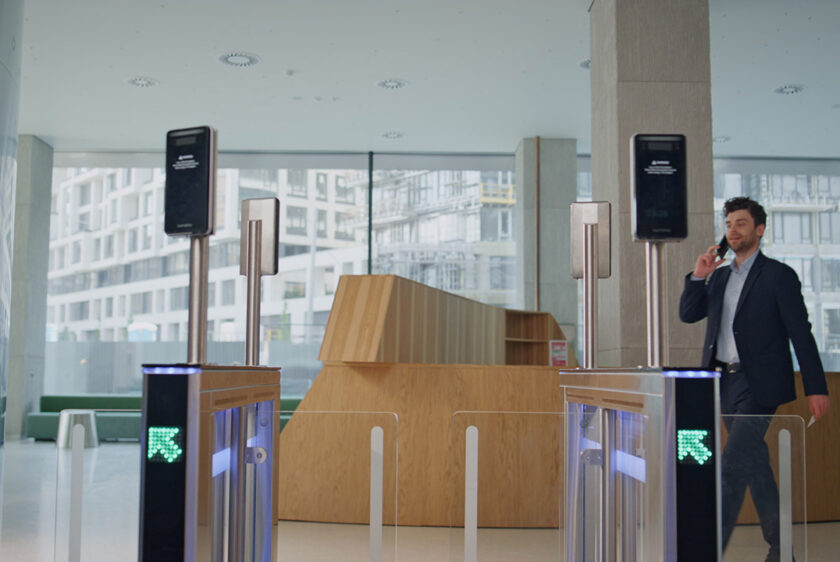
For public entry zones, ticketing integration is the standard model in most UAE entertainment and event venues. The security system integrates with the ticketing platform to verify admission credentials at entry, with the surveillance system recording entry events.
For staff and operational zones, electronic credential systems using proximity cards or mobile credentials are standard. Response time specifications for credential readers at high-traffic staff entry points should reflect operational reality.
For restricted and secure zones, additional authentication layers including PIN or biometric verification are appropriate. The specification should define the authentication requirements for each zone level explicitly.
Integration Architecture
The integration architecture for a high-traffic UAE venue security system is typically more complex than the camera and access control specifications individually. The specification needs to address:
- VMS to access control: credential events surface relevant camera feeds automatically, and alert correlation between surveillance and access events
- Security to building management: integration with fire alarm systems for emergency response protocols, including camera preset positioning and access control door release on fire alarm activation
- Security to venue operations: alert routing to venue operations staff for non-security events detected by the security system, including crowd density warnings
- Security to external agencies: where required by the venue classification, data sharing interfaces with UAE police or civil defence
For detailed guidance on VMS integration architecture, see our article on why a VMS is the backbone of modern security.
Common Specification Errors in UAE High-Traffic Venue Projects
Several specification errors appear consistently in UAE venue security projects.
The most common is specifying camera counts before defining coverage requirements. Starting with a target camera count and working backwards to coverage produces systems with gaps and redundancies that do not reflect the actual operational requirements.
The second is under-specifying network infrastructure. AI analytics cameras generate more data than the conventional cameras they replace. Network infrastructure specifications based on the previous system’s data load will be inadequate from day one.
The third is treating integration as a phase two activity. Integrations that are not specified before procurement are rarely delivered to the quality needed.
The fourth is over-specifying analytics in low-risk areas to match the specification for high-risk zones. Zone-specific specification is more cost-effective and more operationally appropriate.
Frequently Asked Questions
What is the most important specification decision for a high-traffic UAE venue?
The analytics specification, zone by zone. Camera hardware matters, but the analytics capability determines the operational value of the surveillance investment. Specify analytics requirements for each zone before selecting camera hardware.
How do UAE data protection requirements affect venue security specification?
The UAE Personal Data Protection Law requires documented retention policies, access controls for footage review, and audit trails. These need to be built into the specification, including storage capacity planning for retention period compliance.
Should venue security specification include biometric access control?
Biometric access is appropriate for restricted and secure zone access where the number of authorised users is limited. For high-throughput public entry points, ticketing integration or proximity card systems offer better throughput without sacrificing security.
What network bandwidth should be specified for an AI analytics camera deployment?
Calculate bandwidth requirements per camera based on video stream quality and analytics metadata, then add a 30 percent margin for peak load conditions. Network infrastructure should be specified for the peak, not the average, data load.
Can Samcom provide technical input during the tender specification phase?
Yes. Samcom works with security consultants during pre-tender specification and can provide technical documentation, site survey support, and product-level specifications. Contact the team through the project enquiry page.