
How AI-Driven Security Solutions Are Protecting the UAE’s Highest-Profile Public Venues.
The UAE is home to some of the most visited public venues in the world. Major theme parks, landmark retail destinations, large-scale hospitality developments, and iconic entertainment venues attract millions of visitors every year. Keeping those visitors safe is a serious operational responsibility, and the technology doing it has changed significantly over the past decade.
AI-driven security solutions are now at the centre of how the UAE’s highest-profile public venues manage that responsibility. Not as a futuristic concept. As operational infrastructure that is running right now, across sites that tens of thousands of people visit every day.
This article explains what AI-driven security solutions actually do in a public venue context, why they represent a genuine step forward from conventional surveillance, and what end users should understand when evaluating a security system for their own organisation.
What AI-Driven Security Solutions Actually Do
The term gets used loosely, so it is worth being specific. AI-driven security solutions in a physical security context refers to systems where cameras, access control platforms, and video management software use machine learning to analyse what they see and make decisions based on that analysis, without requiring a human to review every frame.
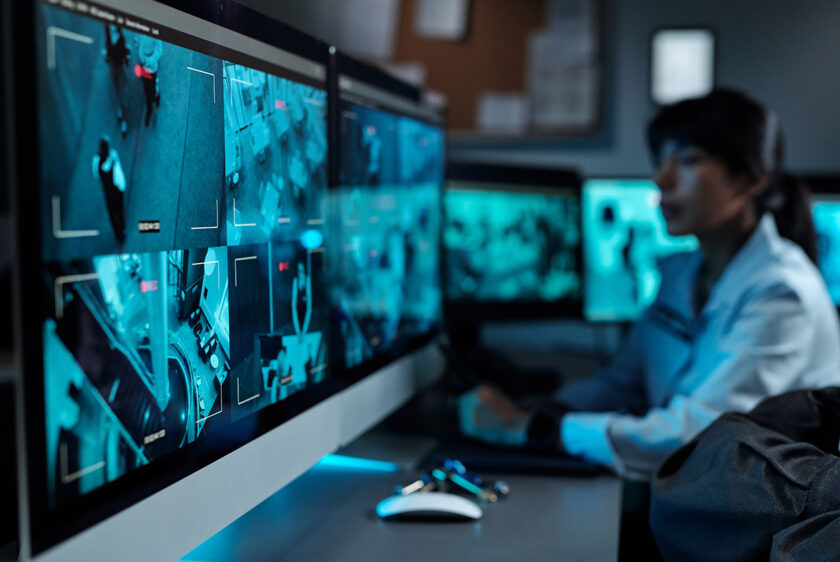
In a busy public venue, this matters enormously. A security operations team monitoring a grid of camera feeds can realistically watch perhaps 10 to 15 feeds with meaningful attention. A major entertainment venue might have 300 cameras across its site. Without AI assistance, the majority of that coverage is effectively passive recording rather than active security.
AI changes that ratio. The system watches all 300 feeds simultaneously, flags events that meet defined criteria, and surfaces them for human review. The operator’s attention is directed to what matters rather than distributed thinly across everything.
The Core Capabilities in UAE High-Traffic Venues
Crowd Density Monitoring
In venues where crowd levels change rapidly, AI-powered density monitoring tracks how many people are in a defined zone at any given time. When density approaches a threshold, the system generates an alert. Security and operations teams can redirect foot traffic, open additional access routes, or deploy staff to manage the situation before it becomes a safety concern.
This is a capability that genuinely did not exist in practical form before AI analytics. Human observers can estimate crowd density, but not across a 20-zone venue simultaneously, and not with the consistency and speed that automated systems provide.
Behaviour Detection
AI systems can be configured to flag specific behaviours: loitering in restricted areas, objects left unattended, individuals moving against pedestrian flow, or activity in zones that should be empty at certain times. Each of these is a potential early indicator of a security concern.
The benefit for end users is that detection happens at the point the behaviour occurs, not after an incident has escalated. The system is watching for the precursors, not just the events.
Perimeter Intrusion Detection
For venues with defined perimeters, AI-powered intrusion detection can distinguish between a person crossing a boundary and a leaf blowing across the same space. This dramatically reduces false alarms compared to conventional motion detection, which is one of the most common operational complaints about legacy security systems.
AI-driven camera technology is central to this capability. Our article on the rise of AI in video surveillance explains the technical foundation in more detail.
How Major UAE Venues Apply These Systems
Samcom has delivered AI-driven security solutions across some of the UAE’s most recognisable public venues, including major entertainment destinations, large-scale hospitality developments, and high-traffic retail environments. Across all of them, a few consistent patterns emerge.
First, AI analytics and conventional surveillance are deployed together, not as alternatives. The cameras providing AI analysis are the same cameras providing recorded footage. The system does both simultaneously.
Second, integration between surveillance and access control creates a more complete operational picture. When an AI alert is triggered at a perimeter point, the access control log for that location is immediately available to the responding operator. Context arrives with the alert, not after it.
Third, the operations teams at these venues consistently report that AI-driven systems reduce the volume of false alarms they need to respond to. False alarm fatigue is a well-documented problem with conventional security systems, and it is the first thing most organisations notice improving after making the switch.
Samcom’s project portfolio across UAE public venues is available on the projects page.
What End Users Should Look for When Evaluating AI Security Systems
If you are considering an upgrade to AI-driven security solutions, the technology specification is important but it is not the only thing that matters. A few practical considerations:
- Ask specifically about false alarm rates. A system that generates 50 alerts per shift, most of which turn out to be nothing, is not improving your security operations. Request evidence of false alarm performance from comparable deployments
- Understand what happens when the AI makes an incorrect assessment. No AI system is perfect. You need to know how the system handles edge cases and what the human review process looks like
- Check the firmware and software update commitment. AI-driven systems improve over time through model updates and firmware releases. A manufacturer who provides consistent updates is delivering a system that improves. One who does not is delivering a system that ages
- Consider the operator experience, not just the technology specification. The system is only as good as the team using it. Vendor training and ongoing support matter as much as the hardware
Hanwha Vision, Samcom’s primary technology partner, provides detailed documentation on their AI analytics capabilities. Visit the Hanwha Vision website for product-level specifications.
AI-Driven Security Solutions and the UAE Regulatory Context
Deploying AI-driven security solutions in the UAE, particularly in public venues, sits within a regulatory context that is worth understanding. Video surveillance data is personal data under the UAE Personal Data Protection Law. Retention periods, access controls, and data management practices all need to be defined and documented.
AI systems that process biometric data, such as facial recognition, carry additional obligations. Most of the crowd analytics and behaviour detection capabilities described in this article do not require biometric processing. But the distinction matters, and any system specification should be clear about which AI capabilities are being used and what data they process.
The UAE Cybersecurity Council publishes guidance relevant to organisations deploying AI-enabled technology in security applications.
Frequently Asked Questions
What are AI-driven security solutions in the context of UAE public venues?
AI-driven security solutions use machine learning to analyse camera feeds and access control data in real time, detecting specific events, behaviours, and conditions without requiring a human to review every feed manually. In public venues, this includes crowd density monitoring, behaviour detection, perimeter intrusion detection, and automated alerting.
Are AI-driven security systems more expensive than conventional surveillance?
The upfront cost of AI-capable cameras and software is higher than basic CCTV. However, the operational cost comparison is different. AI systems reduce staffing required for effective monitoring, reduce false alarm response costs, and provide earlier detection. Most organisations find the total cost over three to five years is comparable or lower.
Do AI security cameras work in the UAE’s outdoor conditions?
Yes. Professional-grade AI cameras from manufacturers like Hanwha Vision are designed for outdoor deployment in high-temperature environments. Wide Dynamic Range processing handles the challenging lighting conditions typical of UAE outdoor spaces, from direct midday sun to low-light evening conditions.
Does Samcom provide training on AI security systems?
Yes. Samcom’s project delivery includes operator training as a standard component. This covers how to interpret AI alerts, how to configure detection zones, and how to use the video management platform to respond to incidents effectively.
How do I get a quote for an AI-driven security solution?
Contact Samcom directly through the project enquiry page to discuss your venue requirements and receive a proposal.